
3 days from Fes to Merzouga
Cedar forests of the Middle Atlas · Ziz Valley · Erg Chebbi dunes · Gnawa music of Khamlia
Ends in FesPrice on WhatsApp

Fes and Merzouga are about 470 kilometres apart, and in a single day the landscape changes completely: from the cedar forests of the Middle Atlas to the high plateau, from the palm-filled canyons of the Ziz to the Erg Chebbi dunes. Here is what to see between Fes and Merzouga, stop by stop.
The road leaves Fes heading south, climbs into the Middle Atlas via Ifrane and Azrou, crosses the plateau to Midelt and goes over the eastern High Atlas at the Tizi n’Talghemt pass. It then drops through the Ziz gorges to Errachidia and follows the valley via Erfoud and Rissani to Merzouga.
It’s about 470 kilometres: around 7 or 8 hours of driving, and 8 to 10 with stops. Leave Fes early and you’ll reach the dunes in time for sunset.
About 65 kilometres from Fes and at 1,665 metres above sea level, Ifrane surprises you with its steep-roofed houses, its parks and its stone lion, the must-have photo. It’s a mountain town with an Alpine feel, very different from the rest of the country, and in winter it sometimes snows.
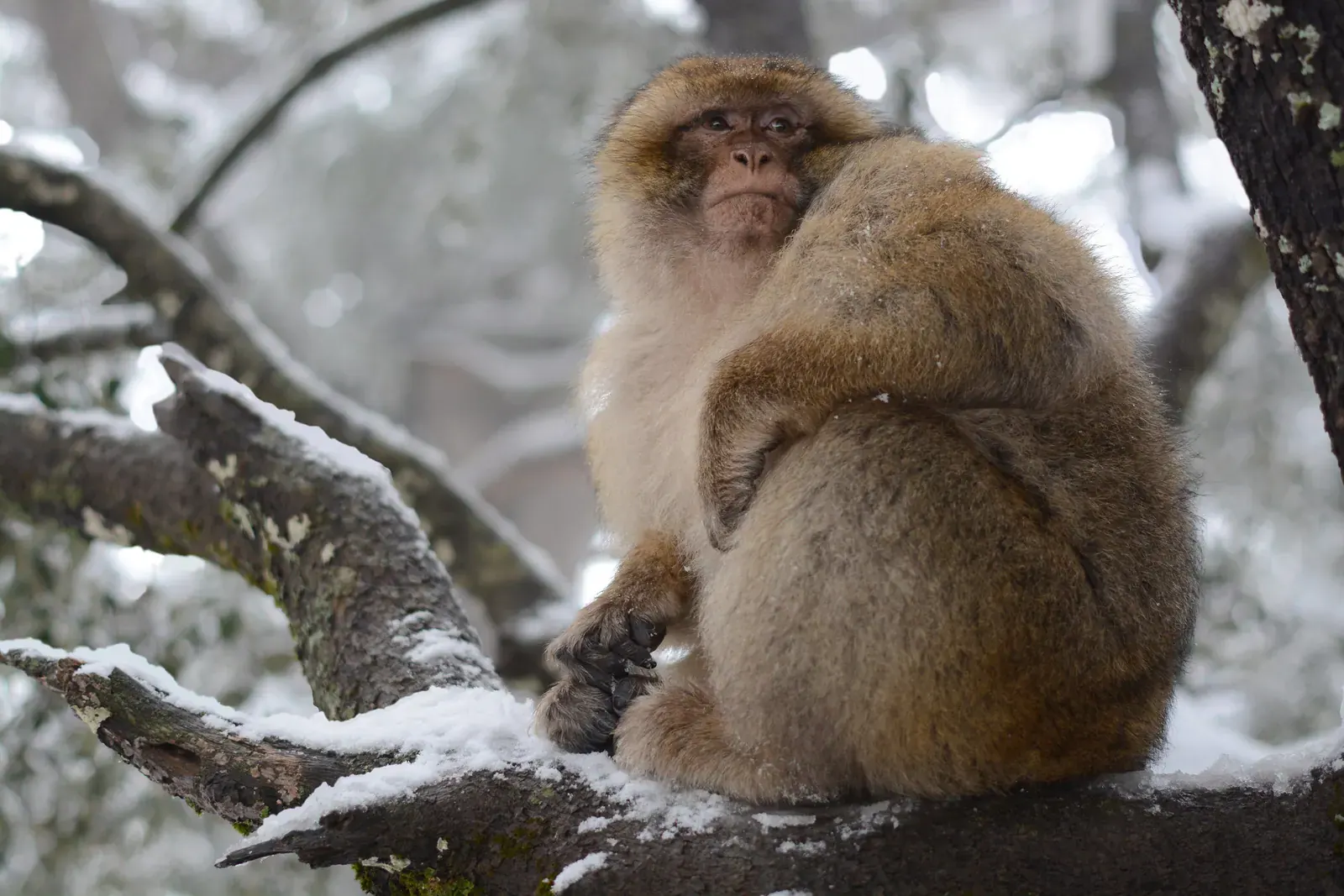
Between Ifrane and Azrou, the road crosses the Atlas cedar forest, inside Ifrane National Park. Barbary macaques, an endangered species, live wild here, and it’s easy to spot them by the roadside. They’re wild animals: don’t feed them.
Midelt sits on a plateau at about 1,500 metres, between the Middle and High Atlas. It’s Morocco’s apple capital, with its festival in October, and its shops sell minerals from the local mines. It’s the usual lunch stop, more or less halfway.
Past Midelt, the road crosses the eastern High Atlas over the Tizi n’Talghemt pass, at about 1,900 metres. On the other side the landscape turns to bare rock and the south begins.
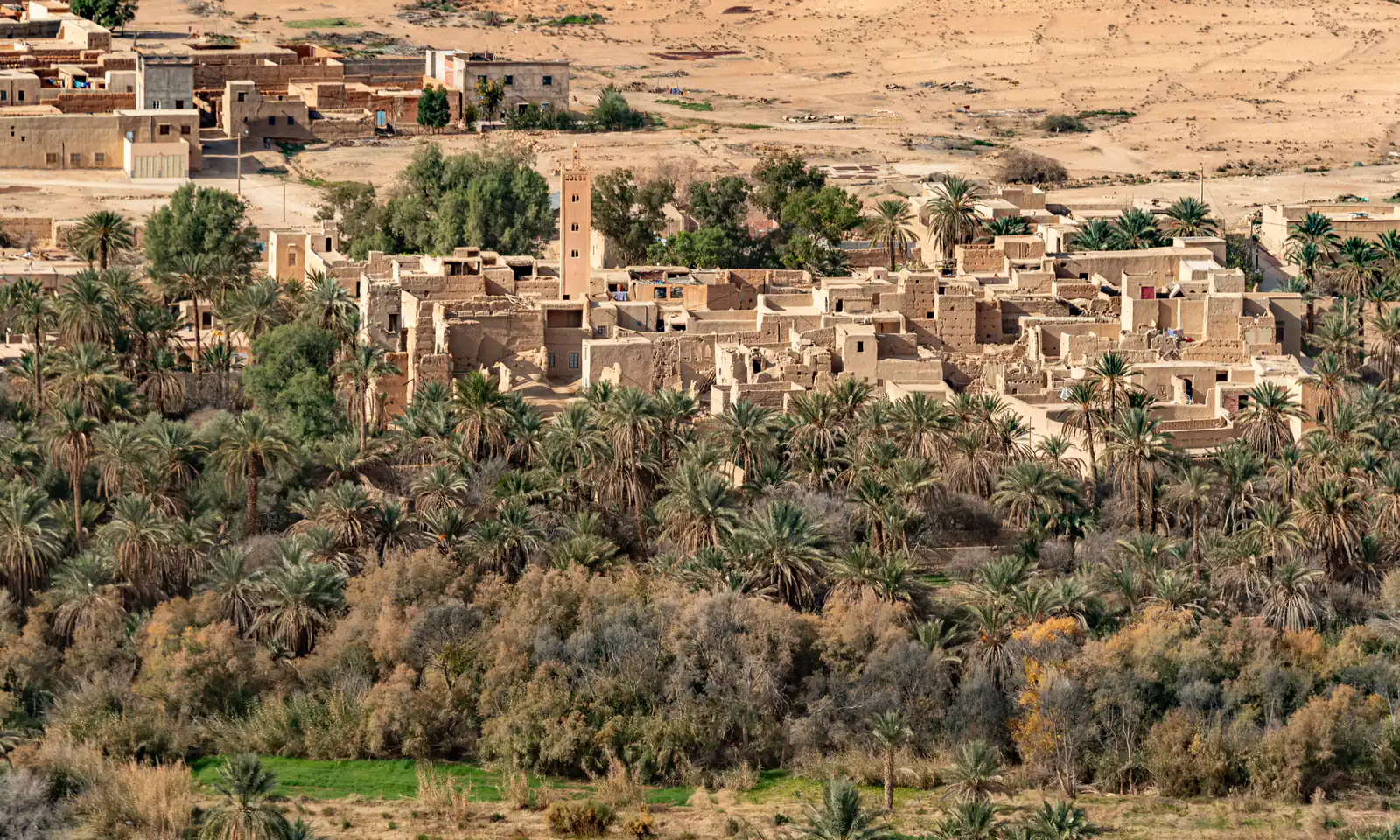
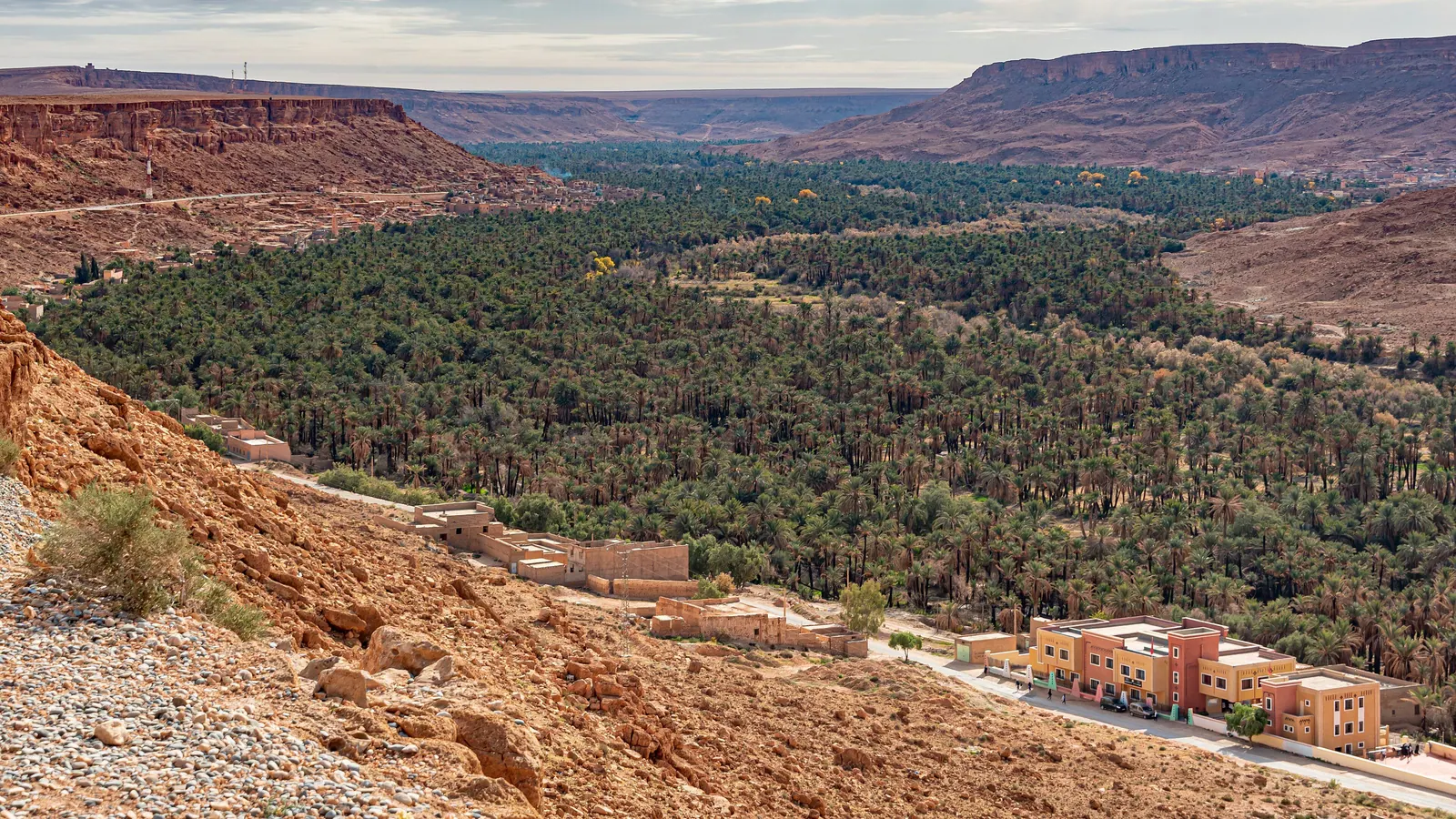
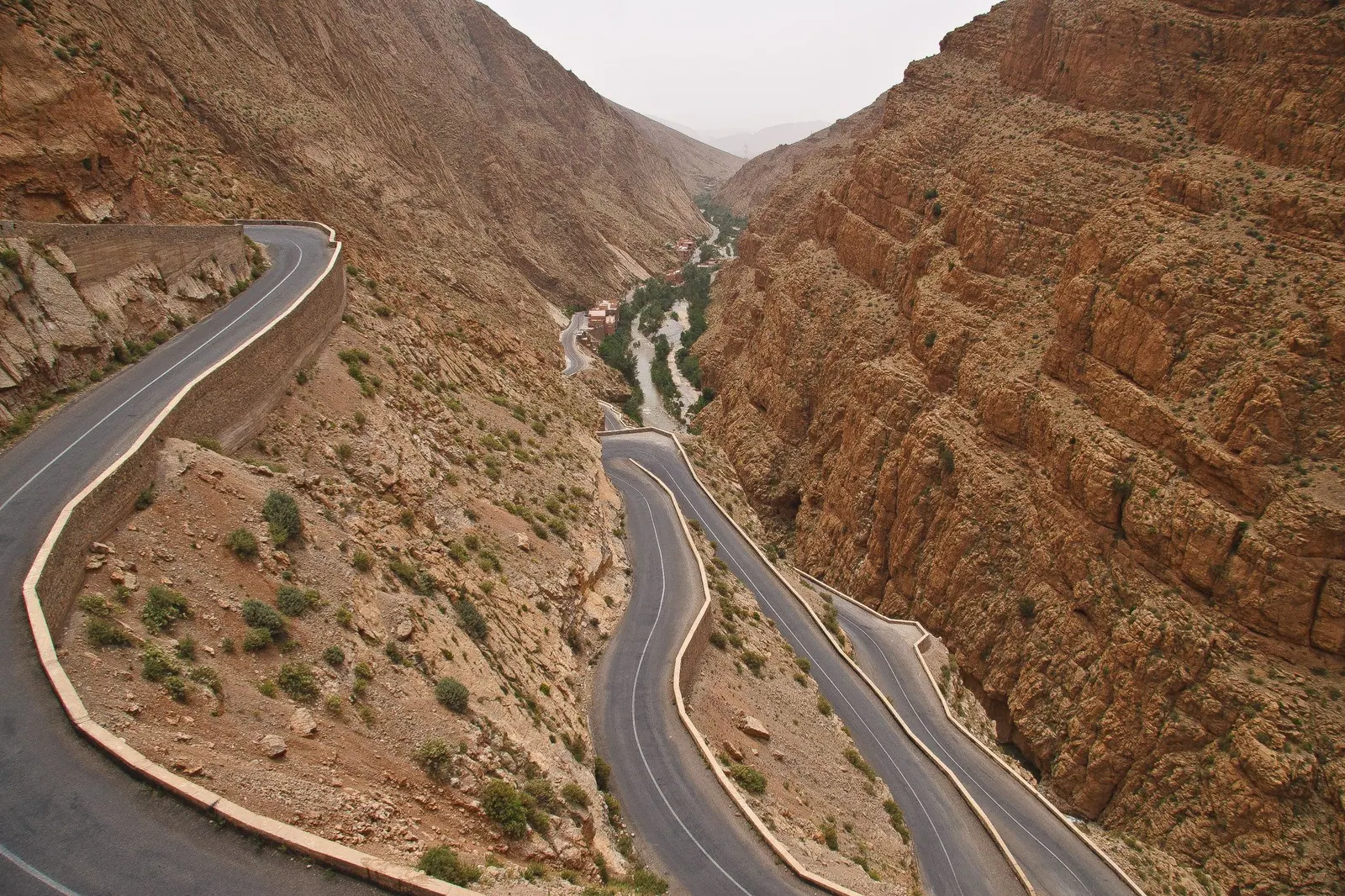
The Ziz river cuts through the Atlas in a canyon with palm trees on its floor. The road goes through the Legionnaire’s Tunnel, carved into the rock during the French protectorate, and passes the Hassan Addakhil dam, close to Errachidia. There are viewpoints to stop at.
Errachidia is the regional capital. About 20 kilometres away, on the road to Erfoud, is the Source Bleue de Meski, a spring with a pool below the ruins of a ksar, a good stop to stretch your legs.
From Errachidia, the road follows the Ziz palm grove, one of the largest oases in Morocco. Erfoud is the town of fossils: in its workshops they cut and polish black stone full of ammonites and orthoceras from when this was a sea. In autumn it holds its date festival.
Rissani is the cradle of the Alaouite dynasty, with the mausoleum of Moulay Ali Cherif and a large souk. Half an hour later the Erg Chebbi dunes appear: you’re in Merzouga.
It’s the shortest drive to the dunes from a big city: leave Fes in the morning, reach Merzouga for sunset, spend a full day in the desert and head back on the third day.
In 3 days you get a full day in Merzouga: a 4x4 excursion around the area, quad or buggy on the dunes, or simply a rest.
Most people don’t retrace their steps: from Merzouga you carry on to Marrakech via the Todra and Dades gorges, Ouarzazate and Aït Ben Haddou. That way you see half of Morocco in a single trip.
The best thing about this drive is watching everything change in just a few hours. You leave a medieval city and cross a cedar forest with monkeys, a high and almost empty plateau, a mountain pass, a palm-filled canyon, an oasis that runs for kilometres and, finally, the desert. That’s why it’s worth doing in daylight and without rushing, stopping wherever the scenery calls for it.
The route from Fes reaches Merzouga in the late afternoon, in time to ride a camel up the dunes at sunset or, if you’d rather not ride, to head to camp by 4x4. If you stay an extra day, the 4x4 excursion around the area takes you to what you can’t see from the road: the nomad families, Khamlia and the Mfis mines.
About 470 kilometres: around 7 or 8 hours at the wheel, and 8 to 10 with stops.
In the cedar forest between Ifrane and Azrou, often by the roadside. They’re Barbary macaques, a wild and endangered species: don’t feed them, and sightings can’t be guaranteed.
In Midelt, which is roughly halfway.
Yes. Leave in the morning and you’ll reach the dunes for sunset.
The desert is closer to Fes: about 470 kilometres, compared with 560. Many travellers combine both: they arrive from Fes and carry on to Marrakech via the gorges and the kasbahs.
Cedar forests of the Middle Atlas · Ziz Valley · Erg Chebbi dunes · Gnawa music of Khamlia
Ends in FesPrice on WhatsApp

Cedar forests of the Middle Atlas · Ziz Valley · Erg Chebbi dunes · Rissani souk · Todra Gorge
Ends in MarrakechPrice on WhatsApp
Cedar forests of the Middle Atlas · Ziz Valley · Dades Valley · Todra Gorge · Erg Chebbi dunes
Ends in FesPrice on WhatsApp